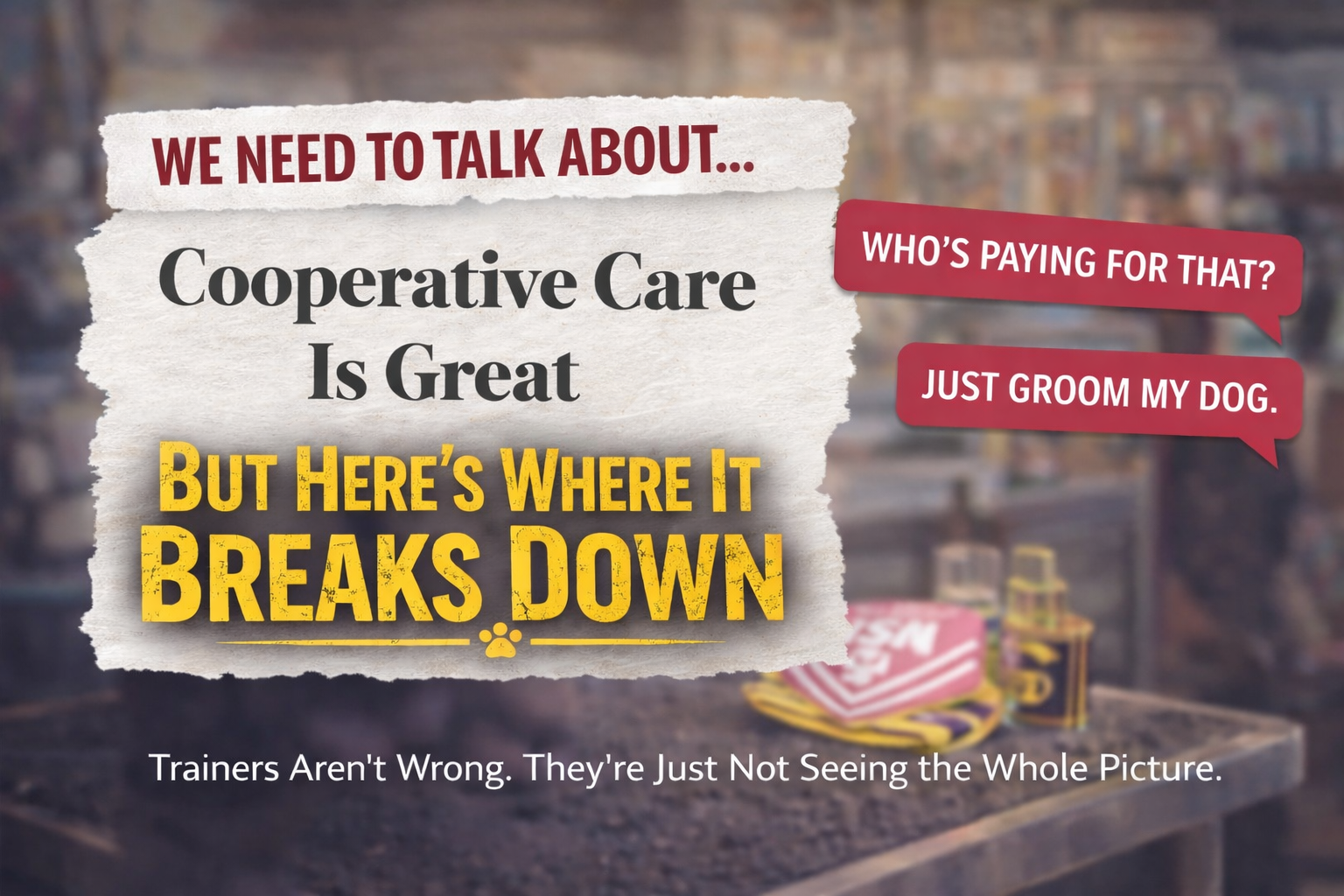
I recently came across a Facebook post from a trainer that sparked a lot of discussion around cooperative care in grooming. It was one of those moments where you can see the intention was good, but the conclusions didn’t quite line up with the reality of what happens in a working salon. It’s a conversation that comes up often, and it highlights a growing disconnect between how grooming is being discussed and how it actually functions day to day.
Cooperative care has become one of the most talked-about concepts in the grooming and training world, and for good reason. Dogs that are regularly handled, properly maintained, and thoughtfully introduced to grooming tend to have a far better experience. When the foundation is there, everything about the process becomes easier for the dog and for the groomer.
The problem isn’t the concept itself. The problem is how it’s being applied to real-world grooming environments.
Most cooperative care models assume time, consistency, and repetition in a controlled setting. They rely on gradual exposure, staying under threshold, and building tolerance over multiple sessions. That framework works well in training environments or in homes where owners are actively participating in the process.
A grooming salon is not that environment.
What groomers are typically working with is a dog that arrives every six to twelve weeks, sometimes longer, with varying levels of maintenance in between. Many of these dogs have not been conditioned for handling. Some are matted, uncomfortable, or already stressed before the appointment even begins. And unlike a training session, the groom cannot be paused and resumed at a later date. The dog is there, the tools are in use, and the service needs to be completed safely.
This is where the disconnect becomes obvious.
There is also a practical reality that is often overlooked in these conversations: cost. Grooming is already a service that many clients are reluctant to pay for. Introducing a model that requires significantly more time by slowing down the process, working in smaller increments, and building cooperative behavior during the appointment, inevitably increases the price of that service. In most cases, clients are not willing to absorb that cost. They are not seeking a training session; they are seeking a completed groom.
Without client buy-in, cooperative care cannot function as intended within a salon setting. It requires consistent work outside of appointments, regular handling at home, and a willingness to invest both time and money into the process. When those elements are missing, the responsibility is often shifted onto the groomer to achieve the same outcome within a single appointment.
That expectation is not realistic.
When a dog begins to struggle during grooming, the groomer is balancing multiple factors at once: safety, time constraints, the dog’s tolerance, and the condition of the coat. In those moments, decisions are made based on what will safely complete the groom, not on what would ideally build long-term behavioral change. That may mean continuing through a task when a trainer would pause, or completing a necessary step rather than breaking it into smaller training increments.
This is not a failure of the groomer. It is a reflection of the environment and the constraints of the work.
Cooperative care is not wrong. It is simply incomplete when it is discussed without acknowledging the limitations of time, consistency, and client participation within a grooming business. Groomers are not operating in controlled training settings. They are working within a service model that requires efficiency, safety, and completion.
Better grooming experiences do not begin on the table. They begin at home, long before the appointment, and they require ongoing effort outside of the salon.
Until that piece is consistently addressed, cooperative care will continue to fall short of expectations in the places it is being asked to function the most.