A grooming convention can be one of the best places to learn, compare equipment, meet manufacturers, and see products you would normally have to order without touching first.
It can also become a very expensive weekend of buying things because they were shiny, discounted, demonstrated beautifully, or described as something every serious groomer apparently needs immediately.
Convention vendors are there to sell. That is not a criticism. It is their job. Your job is to decide whether a product solves a real problem in your business well enough to deserve your money.
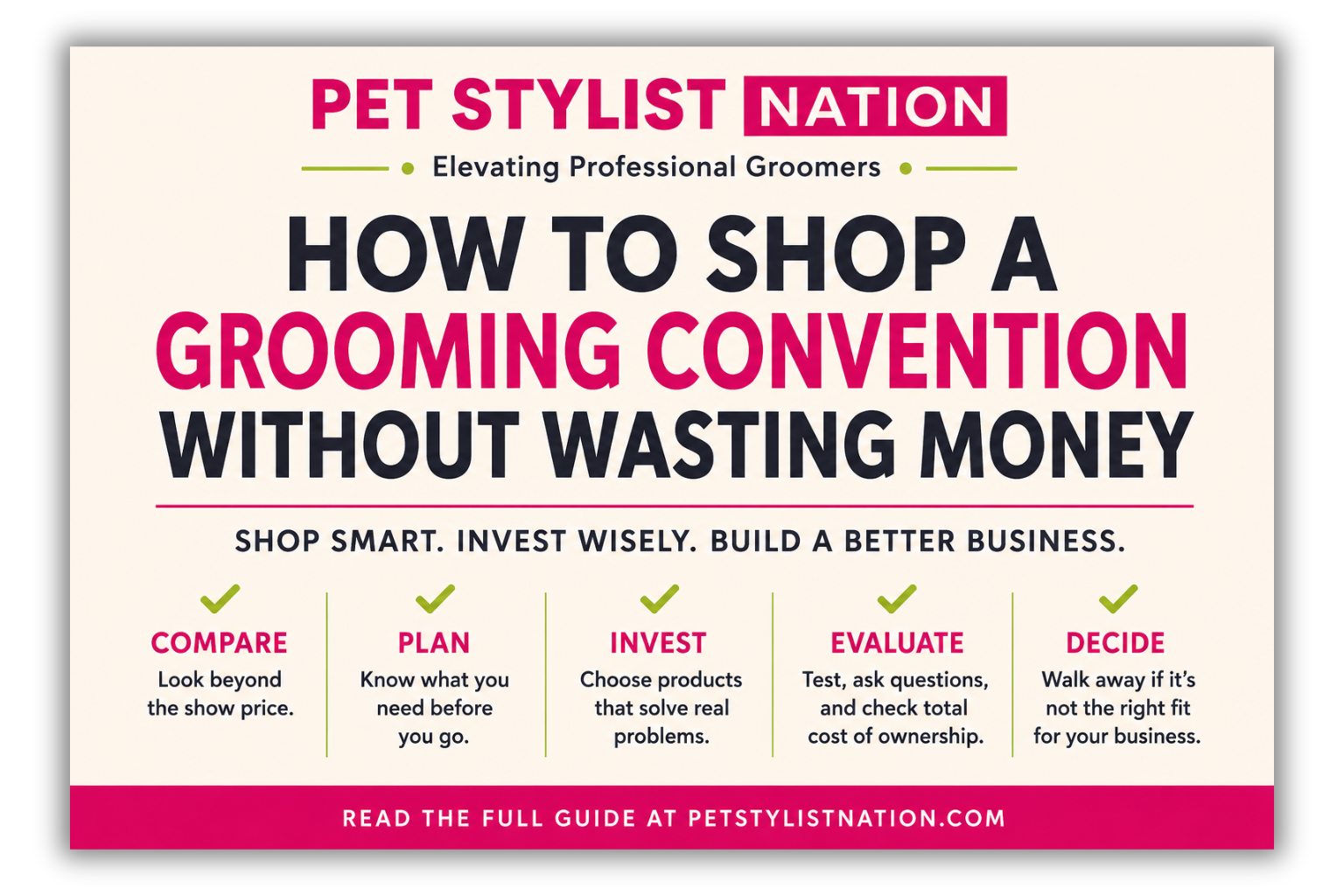
The easiest way to shop a grooming convention wisely is to make those decisions before you are standing in front of the booth.
Start With the Problem, Not the Product
Before the convention, write down the problems you are genuinely trying to solve.
Perhaps your current dryer is slowing down every heavily coated dog. Your clipper is reliable, but the weight is becoming uncomfortable. Your storage setup wastes time. You need a better bathing system, more dependable shears, or software that reduces administrative work.
Those are purchasing problems.
“Everyone seems to have one” is not a purchasing problem. Neither is “it looked impressive during the demonstration.”
A useful purchase should improve something measurable. It might reduce drying time, physical strain, maintenance, product waste, scheduling errors, or the amount of time spent completing a service. If you cannot explain what the item is supposed to improve, you are probably not ready to buy it.
This one step eliminates a surprising amount of convention spending.
Set a Budget Before You Arrive
Decide how much you are prepared to spend before entering the trade show floor.
That budget should account for more than equipment. Include classes, travel, meals, lodging, shipping fees, checked baggage, and the collection of small purchases that somehow becomes several hundred dollars by Sunday afternoon.
It may help to divide the shopping budget into categories:
- Planned purchases
- Replacement tools and supplies
- Education
- One discretionary purchase
The discretionary category gives you some room to enjoy the convention without pretending you will exercise perfect restraint in a building full of grooming equipment. We are planning realistically here.
Once that money is gone, stop shopping. A show special does not become affordable simply because someone wrote the original price in red and crossed it out.
Research Major Purchases in Advance
A convention is an excellent place to make a final decision. It is a poor place to begin researching an expensive product from scratch.
Before attending, compare the products you are seriously considering. Read specifications, manufacturer information, warranty terms, independent reviews, and discussions from professionals who have used the equipment over time.
Create a short list of models you want to inspect in person.
This gives you something more useful than a vague plan to “look at dryers.” You arrive knowing which dryers may fit your workload, what questions remain unanswered, and what competing models you need to compare.
You are also less vulnerable to a persuasive demonstration. Nearly every piece of equipment performs beautifully when operated by someone who demonstrates it all day.
The more useful question is how it performs during your eighth dog on an ordinary Wednesday.
Compare the Total Cost, Not Just the Show Price
The convention price is only one part of the purchase.
Before buying, consider the total cost of ownership. Depending on the product, that may include:
- Replacement filters, brushes, blades, batteries, hoses, or parts
- Routine maintenance
- Repairs and servicing
- Shipping costs
- Required accessories
- Product compatibility
- Electrical or plumbing changes
- Training or subscription fees
- Downtime when something breaks
A dryer that costs slightly less but has expensive replacement parts may not be the better value. Software with an attractive introductory rate may become considerably less attractive once the full subscription price begins. A grooming table may require freight shipping that erases most of the convention discount.
Ask for the complete cost before handing over your card.
Know the Difference Between a Discount and a Good Purchase
A discount saves money only when the item was worth buying in the first place.
Saving twenty percent on equipment you do not need is still spending eighty percent unnecessarily.
Show pricing can be valuable, especially on purchases you already intended to make. It can also create pressure to decide before you have enough information. Ask whether the convention price is truly exclusive, how long it remains available, and whether the same promotion will be offered online after the event.
Sometimes the answer is that you must purchase immediately. Sometimes the deadline is more flexible than the sign suggests.
Either way, do not let the discount make the decision for you. The product still needs to fit your work, budget, space, and business model.
Test Everything You Can At the Grooming Convention
One of the greatest advantages of a convention is the ability to handle equipment before buying it.
Pick up the clipper. Check the balance. Listen to the dryer. Adjust the table. Open the software. Hold the shear. Examine the construction. Ask to perform the task the product is designed to handle rather than simply watching someone else perform it.
Pay attention to the details that affect daily use.
How heavy does the tool feel after several minutes? Can you comfortably reach the controls? Is the hose flexible? Does the table wobble? How difficult is the equipment to clean? Can you replace ordinary wear parts yourself? Is the software understandable without a guided demonstration?
Your own body, workspace, clientele, and working habits matter. A product can be excellent and still be wrong for you.
Ask Better Questions at the Booth
“Is this a good product?” rarely produces useful information.
Ask questions that reveal whether the product fits your actual work.
For equipment, ask about the warranty, repair process, replacement parts, expected maintenance, noise level, weight, electrical requirements, common wear points, and how long the company expects to support the model.
For tools, ask about sharpening, servicing, materials, intended coat types, replacement components, and whether the tool can be tested.
For software, ask about contracts, cancellation, data export, payment processing fees, support hours, migration assistance, price increases, and which features cost extra.
For shampoos and consumable products, ask about dilution, shelf life, ingredient documentation, availability after the convention, and whether small trial sizes are available.
One particularly useful question is:
“What type of groomer would probably not benefit from this?”
A knowledgeable, trustworthy representative should be able to answer that. No product is ideal for every groomer, every salon, and every workload.
Find Out What Happens After the Sale
Convention demonstrations focus naturally on what happens before the purchase. Your business will live with what happens afterward.
Ask who handles customer service. Find out how warranty claims work, where repairs are completed, how long replacement parts usually take to arrive, and whether technical support is provided by the manufacturer or a distributor.
This matters especially with large equipment, electronics, software, and products that can stop salon operations when they fail.
A strong convention discount loses some charm when a repair requires shipping a 90-pound machine across the country at your expense.
Look beyond the product itself. You are also buying the company’s support, parts availability, and willingness to help when the impressive booth demonstration is a distant memory.
Be Careful With Products You Cannot Return
Before purchasing, ask for the return policy in writing.
Convention sales may follow different rules from ordinary online purchases. Some products may be final sale. Others may be returnable only if unused, subject to restocking fees, or shipped back at the buyer’s expense.
This is especially important for shears, clippers, apparel, electronics, and equipment that may feel different after extended use.
Do not assume you can return something because you normally could when ordering from the company’s website. Ask before buying, and keep every receipt, warranty document, and representative’s contact information.
Photographing the paperwork is not excessive. It is what we do now because tiny paper receipts apparently enjoy disappearing into another dimension.
Do Not Buy Equipment You Cannot Support
A product may fit your work but not your current business.
Before buying, consider whether you have the space, electrical capacity, plumbing, transportation, maintenance budget, and workload necessary to use it properly.
A mobile groomer has different limitations from a large salon. A home-based groomer may need to consider noise, ventilation, and available power. A new groomer may not yet know which tools will meaningfully improve their work.
There is nothing wrong with deciding that an excellent product belongs on next year’s list.
Buying later is often less expensive than buying too early, storing the item for months, and discovering that your needs changed before you ever used it.
Give Yourself Permission to Walk Away
You do not owe a vendor a purchase because they spent twenty minutes demonstrating something to you.
Thank them. Take the information. Photograph the model number and booth details. Ask for a written quote. Then walk away and compare it with the other options.
For larger purchases, consider using a waiting period. Even an hour away from the booth can make the decision clearer. For very expensive equipment, waiting until the next day may be wiser.
A product that genuinely fits your business will still make sense after lunch.
The trade show floor is designed to be exciting. Stepping away gives you a chance to determine whether you are excited about the solution or simply caught up in the environment.
Keep Track of What You Learn
Use your phone, a notebook, or a simple convention worksheet to record:
- Product and model
- Booth number
- Quoted price
- Standard price
- Shipping cost
- Warranty
- Return policy
- Required accessories
- Representative’s contact information
- Questions still unanswered
- Your first impression
Do not rely on memory after visiting dozens of booths. By the end of the day, the three black clippers you compared will have merged into one vaguely familiar clipper-shaped thought.
Good notes make it possible to compare products calmly later.
The Purchase Should Still Make Sense After the Convention
A good convention purchase is not necessarily the cheapest or most exciting thing you find.
It is the product that solves a real problem, fits your workload, works within your budget, and offers enough long-term value to justify the cost.
Sometimes that will mean taking advantage of a strong show price. Sometimes it will mean gathering information, testing several options, and buying months later. Sometimes the wisest decision will be leaving the convention with nothing more expensive than lunch and a better understanding of what you actually need.
That is not a wasted shopping opportunity.
That is shopping like a business owner.