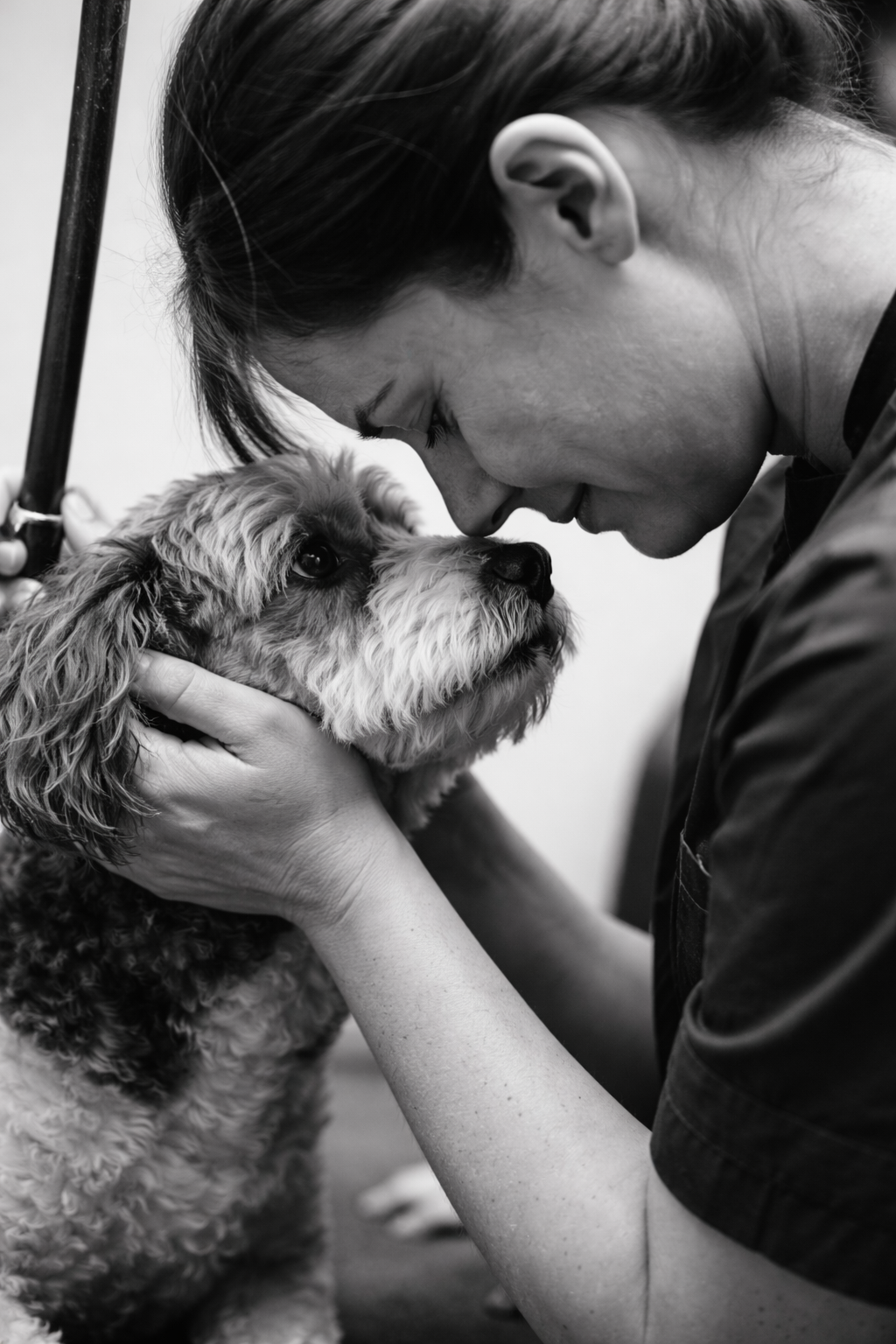
The first thing I told every new hire on their first day was simple:
Every dog that comes through this door is someone’s best friend.
Not a client’s appointment.
Not a line on the schedule.
Not a haircut that’s running behind.
A best friend.
It seems obvious. Almost too obvious to say out loud. But years in this industry will teach you that the obvious things are the first to disappear when the day gets loud.
And grooming days get REALLY loud.
They get loud when a dog screams for a nail trim like it’s a full-scale emergency.
They get loud when the bite history presents itself after the dog is already on the table.
They get loud when you’re behind, understaffed, overbooked, and wondering how it’s only 11:17 a.m.
That’s usually when frustration sneaks in.
Not because groomers don’t care.
But because we care constantly … under pressure, under time limits, under expectations that don’t always match reality.
When you’re wrestling a difficult dog, it’s easy to shrink them down into a problem to solve.
The biter.
The pooper.
The one who hates dryers.
The one that makes your shoulders tense the moment they walk in.
And sometimes that mental shortcut is the only way to keep moving.
But it’s also where things start to crack.
Because that dog didn’t wake up planning to be difficult.
They woke up being a dog, with a nervous system, a history, and a person who trusts us with them.
Somewhere, someone kissed that head goodbye this morning.
Someone worries about how they’ll do.
Someone assumes we’ll handle them with care, even when they’re not at their best.
Remembering that doesn’t magically make the groom easier.
But it does change how we hold ourselves while we do it.
It reminds us to slow our hands when our patience runs thin.
To pause before escalating restraint.
To choose safety over speed, even when the schedule disagrees.
To recognize when today isn’t the day to “push through.”
And maybe most importantly: it keeps us human.
Because groomers aren’t robots, and difficult dogs aren’t failures.
They’re moments where skill, judgment, empathy, and boundaries all meet at once. Some days we handle that beautifully. Some days we go home exhausted, replaying everything in our head.
Both are part of the job.
But if we lose sight of the fact that every dog is deeply loved by someone, even the ones who test us the most, the work gets heavier than it needs to be.
That reminder isn’t about guilt.
It’s about grounding.
It’s about remembering why professionalism in this industry isn’t just technical skill. It’s emotional regulation, situational awareness, and respect for the bond we’re being trusted with.
Every dog is someone’s best friend.
Even on the hard days.
Especially on the hard days.